

Taking control of revenue is key to safeguarding margins and strengthening financial results.
Pathology and laboratory organizations are under increasing reimbursement pressure, and that pressure is coming from more than one direction.
Denials are still part of the challenge, but they are no longer the whole story. Coding complexity, underpayments, partial payments, changing payer rules, narrow networks, and reporting requirements are all putting pressure on financial performance.
In this environment, billing activity alone is not enough. The organizations performing best are the ones that can see where revenue is leaking, understand what they should have been paid, and act before leakage becomes accepted performance.
This is what makes pathology revenue integrity a competitive advantage.
Why many labs struggle to see the full picture
For many organizations, claims may go out on time and payments may continue to come in, but there is still limited visibility into whether reimbursement performance is actually where it should be.
That creates some difficult but important questions.
-
Were claims paid correctly?
-
Where are underpayments happening?
-
Which payer patterns are getting missed?
-
How much staff time is being spent on issues that are not worth pursuing?
-
Which workflow gaps are quietly driving avoidable loss?
These questions matter because pathology revenue leakage often does not announce itself clearly. It happens in ways that are easy to overlook when teams are focused only on billing volume or denial counts.
Where revenue leakage commonly occurs
In pathology and laboratory medicine, revenue leakage tends to show up in a handful of recurring places.
👤Incomplete demographics or eligibility information can create preventable billing friction early in the process.
📄Documentation gaps can lead to downstream reimbursement issues that are difficult to recover.
💻Payer-specific edits that are not built into workflow can affect claims before staff even realize there is a pattern.
⛔Coding mismatches can impact payment accuracy. Underpaid claims may never be surfaced for review.
📉Low-dollar claims may be written off too quickly.
📨Appeals may happen without a coordinated strategy, making it harder to know where effort is actually paying off.
Seen individually, these issues may look manageable. Together, they can create meaningful margin loss.
The problem is not just denials
Denials usually get the most attention because they are visible. They create work queues, trigger follow-up, and show up clearly in reporting.
But some of the most damaging reimbursement issues are the ones that do not stop payment entirely. Partial payments and underpayments are a good example. If teams cannot compare expected reimbursement to actual reimbursement, those losses can continue unnoticed. Over time, that kind of silent leakage can be just as important as denials, if not more so.
That is why high-performing organizations are moving beyond basic billing metrics and taking a broader revenue integrity view.
What high-performing pathology organizations do differently
The strongest pathology and laboratory organizations are not necessarily working more claims. They are building more visibility into reimbursement performance.
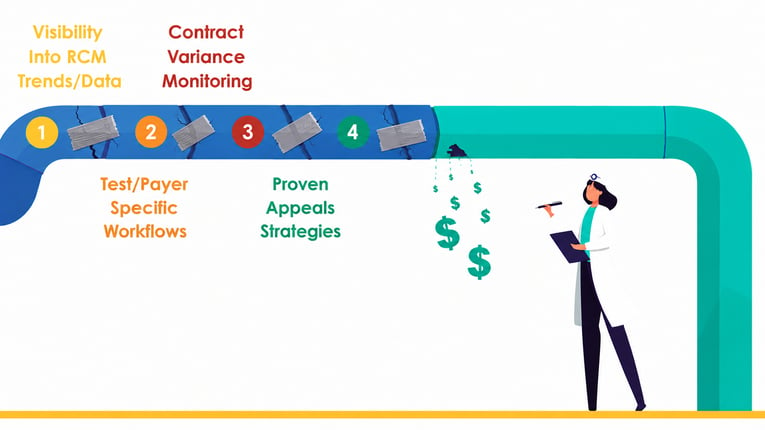
They monitor more than denials. They pay attention to coding trends, underpayments, partial payments, contract variance, and payer-specific patterns. They connect front-end workflow issues to downstream reimbursement outcomes. They prioritize appeals based on where action is most likely to matter. And they create better coordination between data, workflow, and follow-up.
That kind of visibility helps teams focus effort where it will have the biggest impact. It also supports stronger operational discipline at a time when staff resources are stretched and payer behavior is becoming harder to predict.
Stop The Revenue Leakage
Why this matters now
Revenue pressure in pathology is not easing. If anything, it is becoming more fragmented and more difficult to manage.
That means organizations need more than a process for getting claims out the door. They need a clearer way to understand what should have happened, what actually happened, and where breakdowns are affecting reimbursement.
The labs and pathology groups that create that visibility are in a better position to protect margin, improve financial performance, and support growth without simply adding more manual work.
Revenue integrity starts with visibility
The next competitive advantage in pathology is not just speed. It is clarity.
When organizations can see where revenue leakage is occurring, they can make smarter decisions about workflow, appeals, staffing, payer follow-up, and reimbursement strategy. That is what turns revenue cycle from a back-office task into a performance lever.
If your team cannot clearly see where revenue leakage is occurring across denials, underpayments, contract variance, and workflow-driven loss, that is the first place to start. A stronger pathology revenue cycle begins with better visibility into reimbursement performance — and a more deliberate approach to protecting it.
Ready to take a more strategic approach? Connect with us to learn how better insight and smarter strategy can protect your revenue.