
Master prior auth with smarter workflows and cross-functional alignment—turning a bottleneck into faster patient access and stronger financial performance.
Prior authorization has become one of the most significant operational challenges facing diagnostic laboratories. As testing becomes more complex and payers tighten requirements, the process has evolved into a critical function that directly impacts patient care, provider workflows, and revenue cycle performance.
In a recent industry webinar featuring experts from Quadax and careviso, key themes emerged around the growing complexity of prior authorization, the need for smarter automation, and the importance of cross-functional alignment.
Why Prior Authorization Is More Important Than Ever
Prior authorization helps ensure services meet payer requirements before care is delivered, reducing reimbursement risk while supporting medical necessity requirements. While it helps control costs and enforce medical necessity, it also introduces delays and administrative burden.
Several industry shifts are driving its increased importance:
-
Rise in genetic and molecular testing: These high-cost, high-value tests are increasingly subject to PA requirements.
-
Growth in Medicare Advantage plans: Unlike traditional Medicare Part B, Medicare Advantage plans frequently require authorization.
-
Greater payer scrutiny: Insurers are expanding PA requirements rather than reducing them in most cases.
Bottom Line: Despite public discussions about reform, prior authorization volumes are rising—making efficiency in this process a competitive advantage.
The Core Challenges of Prior Authorization
1. Fragmented Data and Limited Access to Information
Laboratories often lack direct access to patient demographics, insurance data, and clinical documentation. Since this information is typically owned by ordering providers, labs must rely heavily on external parties to complete PA requests.
2. Complex and Changing Payer Requirements
Staying current is a significant challenge due to the sheer volume and complexity of payer plans, benefit structures, and policies. Requirements vary widely across commercial insurers, Medicare Advantage plans, and laboratory benefit managers (LBMs), making consistency and accuracy difficult to maintain.
3. Physician-Driven Authorization Requirements
In many cases, only the ordering physician—not the lab—can initiate PA. This creates operational friction and slows down the process.
4. Manual Processes and Administrative Burden
Many organizations still depend on manual methods—such as phone calls, faxes, and portal submissions—which result in longer turnaround times, higher error rates, and increased staffing costs.
Bottom Line: The biggest bottleneck isn’t just the authorization itself—it’s collecting the right data and submitting it correctly the first time.
Optimizing the Prior Authorization Workflow
A typical PA workflow includes:
-
Assessment of requirements
-
Data collection (demographics, clinical info)
-
Submission to payer or LBM
-
Follow-up and status tracking
-
Claim submission
Best Practice: Move Upstream
One of the most effective ways to improve prior authorization outcomes is to start the process as early as possible. Rather than waiting until a test has been performed, leading laboratories are integrating prior authorization into the ordering and patient intake workflow. Combining eligibility verification with prior authorization upfront and leveraging ordering portals or API integrations helps reduce manual work, minimize delays, and improve the likelihood that testing can proceed without reimbursement issues.
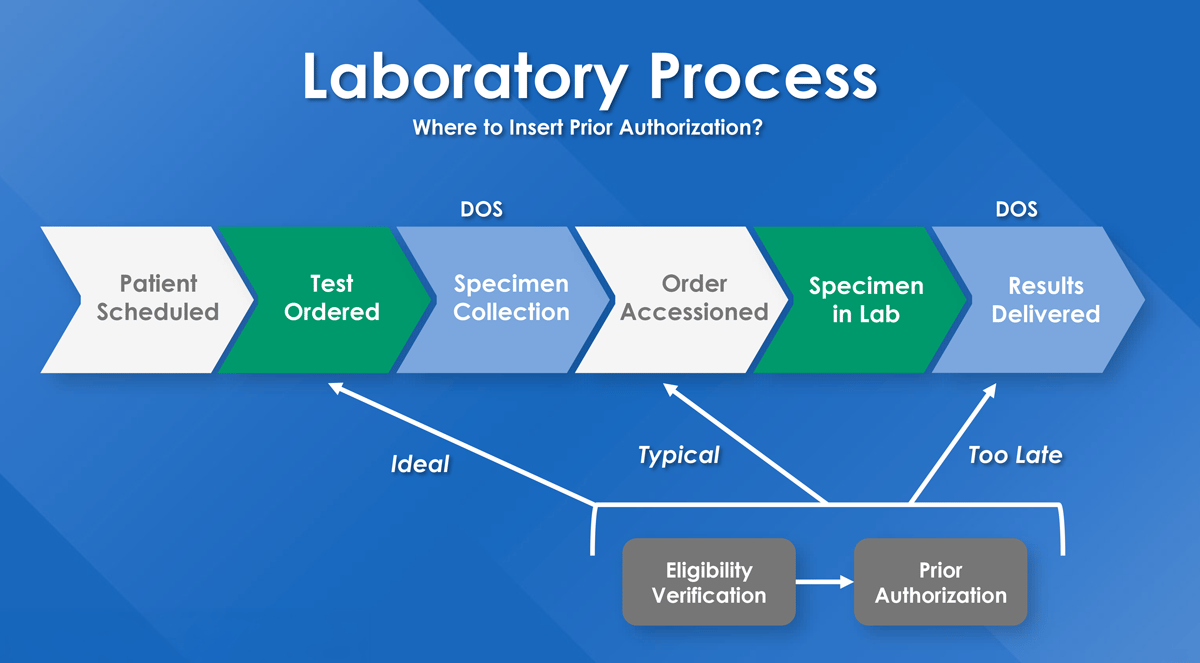
Bottom Line: Waiting until after the date of service to start PA drastically increases denial risk.
The Power of Technology: Automation, AI, and APIs
Automation technology is shifting prior authorization from a manual, reactive process into a proactive, data-driven workflow.
Key Innovations
-
Automation (RPA/APIs): Routes requests to the correct payer instantly
-
AI-powered data extraction: Pulls relevant clinical details from medical records in seconds
-
Real-time eligibility and coverage checks: Prevents errors before submission
Benefits
-
Reduced manual effort
-
Faster approvals
-
Improved accuracy
Important Note: Automation must be paired with human oversight and quality assurance—poorly implemented tech can reduce approval rates.
Metrics That Matter: Measuring PA Success
Tracking performance is essential for continuous improvement. Key metrics include:
1. Prior Authorization Approval Rate
-
Can range widely (low to high performers differ by up to 70%)
-
Driven by data quality, clinical documentation, and adherence to payer medical policy
2. Claim Success Rate After Approval
-
Surprisingly not 100%
-
Issues include coding mismatches and payer inconsistencies
3. Date-of-Service (DOS) Without Authorization
-
Indicates missed opportunities due to late processing or the payer not allowing a retroactive period
-
Often tied to manual delays
4. Revenue Impact
-
Demonstrates ROI of effective PA processes
-
Highlights the cost of missed approvals
Bottom Line: Analytics dashboards are critical for detecting payer changes and identifying systemic issues early.
Teamwork: The Secret to High Performance
Top-performing organizations understand that prior authorization is a cross-functional process requiring seamless coordination across revenue cycle teams, laboratory operations, IT and data teams, as well as market access, clinical, reimbursement experts, and external partners. With clear communication and shared visibility across these groups, organizations can resolve issues more quickly, reduce delays, and drive better overall outcomes.
Bottom Line: Significant improvements don’t always require large IT investments—focused coordination, clear processes, and alignment across stakeholders can drive meaningful results.
Industry Changes and the Road Ahead
1. Regulatory and Policy Trends
Recent legislation and industry initiatives are driving efforts to increase transparency in coverage and pricing, accelerate turnaround times for prior authorization decisions, and improve patient visibility into out-of-pocket costs. However, many of these reforms are still evolving, and their real-world impact remains limited.
2. Interoperability and APIs
The future of prior authorization is rooted in seamless data exchange across systems, where APIs enable real-time communication between providers, laboratories, and payers. As automation reduces reliance on manual processes, pre-service cost estimates, or “good faith estimates,” are becoming a standard expectation, helping improve efficiency and financial transparency for patients.
Bottom Line: Interoperability will transform PA—but complexity means full automation is still a work in progress.
Steps Labs Can Take Today
To improve prior authorization outcomes, focus on these five priorities:
-
Start Early
Initiate eligibility and PA at the ordering stage -
Collect Clean, Complete Data
Ensure clinical and demographic accuracy upfront -
Stay Current on Payer Policies
Monitor changes proactively -
Leverage Technology Wisely
Use AI, automation, and APIs to reduce manual work -
Adopt a Team-Based Approach
Align departments and external partners
Bottom Line: Early action, clean data, smart automation, and cross-functional alignment create a more efficient, predictable prior authorization process.
Conclusion: A Smarter Approach to Prior Authorization
Prior authorization isn’t going away—in fact, it’s becoming more central to healthcare delivery and reimbursement. While the process is undeniably complex, organizations that invest in early workflows, data quality, and smart technology are seeing measurable gains.
The path forward isn’t about eliminating prior authorization—it’s about mastering it. By combining analytics, automation, and cross-functional collaboration, healthcare organizations can shift prior authorization from a persistent bottleneck into a strategic advantage—enhancing both patient access and financial performance.
Want to see these strategies in action? Click on the image below to watch Navigating Today's Prior Authorization Challenges in Diagnostic Testing. Hear industry experts Tom Cronin and Perry Dimas discuss emerging trends, workflow optimization strategies, and practical approaches to improving prior authorization performance.