

Why Partnerships Need to Move Beyond Connectivity.
Healthcare revenue cycle partnerships are changing.
For years, many partnerships were built around one basic expectation: if one system could send claims, receive responses, and exchange data with another, the partnership was considered successful.
That foundation still matters, but it no longer meets the full needs of today’s providers.
As denial pressure grows, provider organizations need more than connected systems. As reported by AJMC, 41% of providers now report denial rates of 10% or higher, and 90% of claim denials are reworked with at least some human review before resubmission. That level of rework makes one thing clear: connectivity alone is not enough.
Revenue cycle leaders need partners that help improve workflows, reduce friction, strengthen visibility, and keep revenue moving. For EHRs, billing platforms, healthcare software vendors, and revenue cycle partners, this shift creates a clear opportunity: deliver more than a connection…deliver measurable value.
Connectivity is the starting point, not the strategy
Interoperability will always be essential in healthcare. Data needs to move accurately and reliably between systems, payers, providers, and partners. But connectivity does not solve the bigger revenue cycle challenges providers face every day such as preventing denials, reducing rework, improving front-end accuracy, or helping teams understand what action to take next.
A strong revenue cycle partnership should support the full workflow around the connection. The goal is no longer just to move information. The goal is to help teams use that information earlier, faster, and more effectively.
Connectivity Alone vs. Strategic Partnership
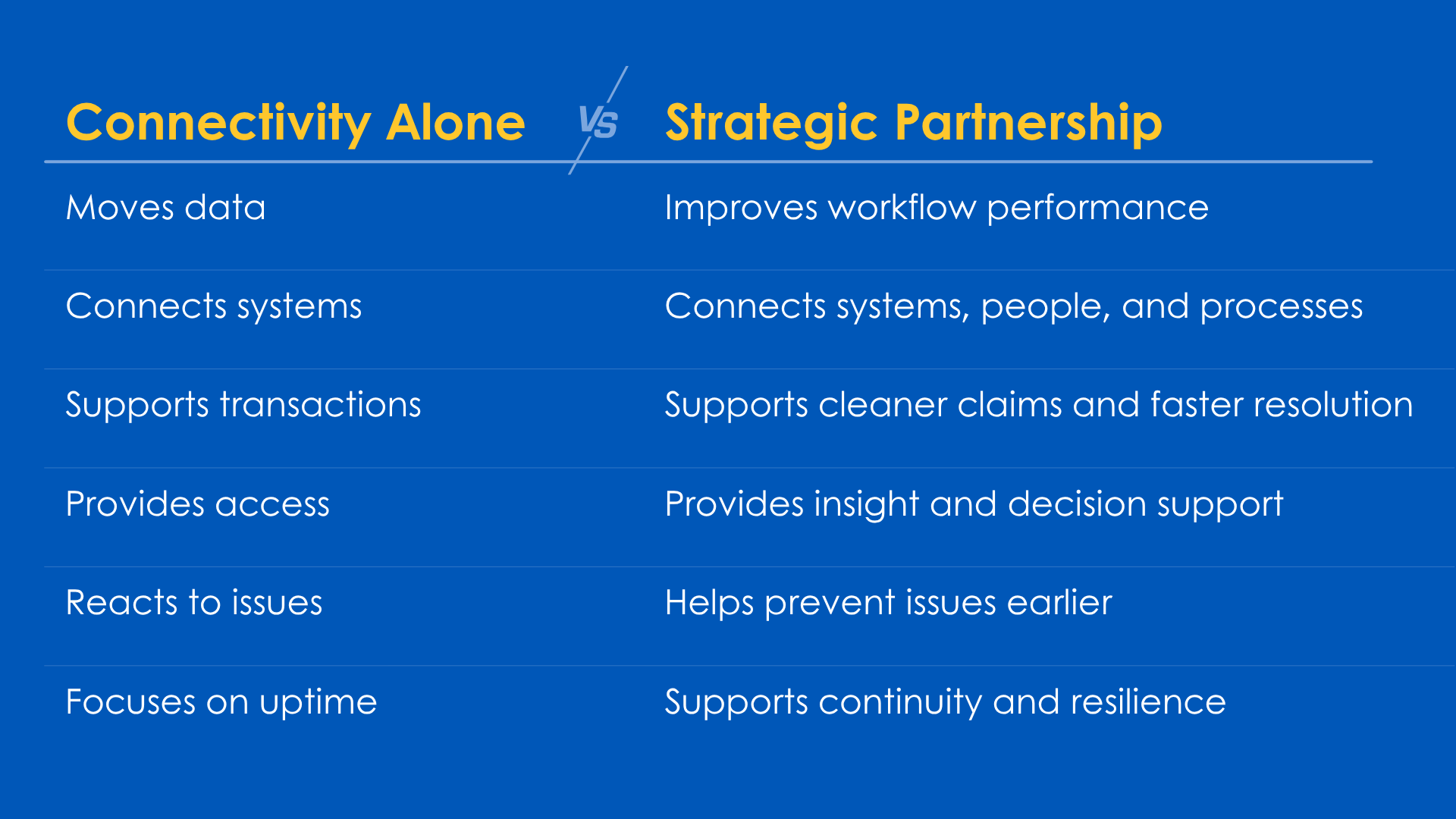
Providers need fewer gaps across the revenue cycle
Revenue cycle work is connected. What happens at the front end often affects what happens later in billing, claims, denials, and reimbursement.
When coverage is not verified correctly, claims may be delayed or denied. When payer rules are difficult to interpret, billing teams spend more time correcting errors. When systems are disconnected, staff are forced to move between tools, search for answers, or rely on manual workarounds.
Modern partnerships should help close those gaps by building relationships that support better front-end accuracy, cleaner claims, faster issue resolution, and more visibility into the factors affecting reimbursement. It also means helping providers reduce the manual burden on their teams while improving the financial performance of the organization.
What Modern Revenue Cycle Partnerships Should Support
A stronger partnership model should help providers improve performance across the revenue cycle, not just connect one system to another.
-
Eligibility and coverage insight
-
Claim editing and denial prevention
-
Reliable payer connectivity
-
Embedded analytics and reporting
-
Decision support that helps teams act sooner
-
Workflow integration that reduces manual effort
-
Continuity planning for disruption readiness
Intelligence is becoming part of partnership value
The next era of revenue cycle partnership will be more intelligent.
As payer rules, denial patterns, and reimbursement requirements become more complex, providers need more than access to data. They need insight that helps them understand what is happening and what to do next.
This is where analytics, predictive tools, and decision support are becoming more important. Strong partnerships can help providers identify issues earlier, reduce avoidable denials, prioritize work by financial impact, and make faster decisions with more confidence.
For technology vendors and healthcare platforms, this creates a stronger value proposition. A partnership that adds intelligence to the workflow can help clients move from reactive problem-solving to proactive revenue cycle management.
Integration should make work easier
A good partnership should make the user experience better, not more complicated.
Healthcare teams already manage multiple systems, payer requirements, reporting needs, and operational demands. Adding another disconnected tool can create more friction instead of less.
That is why integration matters. Strong partner models should support workflows that fit into the systems users already rely on. Whether through API, HL7, FHIR, embedded tools, co-branded solutions, or white-label models, the goal should be the same: reduce workflow disruption and create a more connected experience.
For EHRs, billing platforms, and healthcare software companies, this is especially important. The right revenue cycle partner can help strengthen the platform’s value without forcing users into unnecessary complexity.
Resilience is now part of the conversation
Revenue cycle disruption is no longer a distant concern. When a clearinghouse connection, payer workflow, or primary system is interrupted, the financial impact can build quickly.
The financial impact of disruption can escalate quickly. In a 2024 AHA survey conducted after a major healthcare cyberattack, 94% of hospitals reported financial impact, more than 80% said cash flow was affected, and nearly 60% of impacted hospitals reported revenue losses of $1 million per day or more.
Solutions such as Quadax SafetyNet are becoming an important part of a more resilient revenue cycle framework, helping organizations plan for disruption through backup clearinghouse strategies, secondary vendor options, payer-specific routing flexibility, and operational readiness support. A strong partnership should not only optimize performance during normal operations. It should also help protect performance when disruption occurs.
Trust still matters as much as technology
Healthcare revenue cycle infrastructure carries real financial and operational weight. Providers need partners they can trust with critical workflows, payer connections, reimbursement processes, and client-facing support. For vendors, that trust extends even further. The right partner should strengthen the client experience, not put client satisfaction at risk.
That trust is built through more than technology. It comes from consistent performance, clear communication, reliable service, transparent collaboration, and the ability to support clients through change. As partnerships become more advanced, trust becomes even more important.
How Quadax Supports Partner Success
Quadax works with partners to support a more connected, intelligent, and resilient revenue cycle experience.
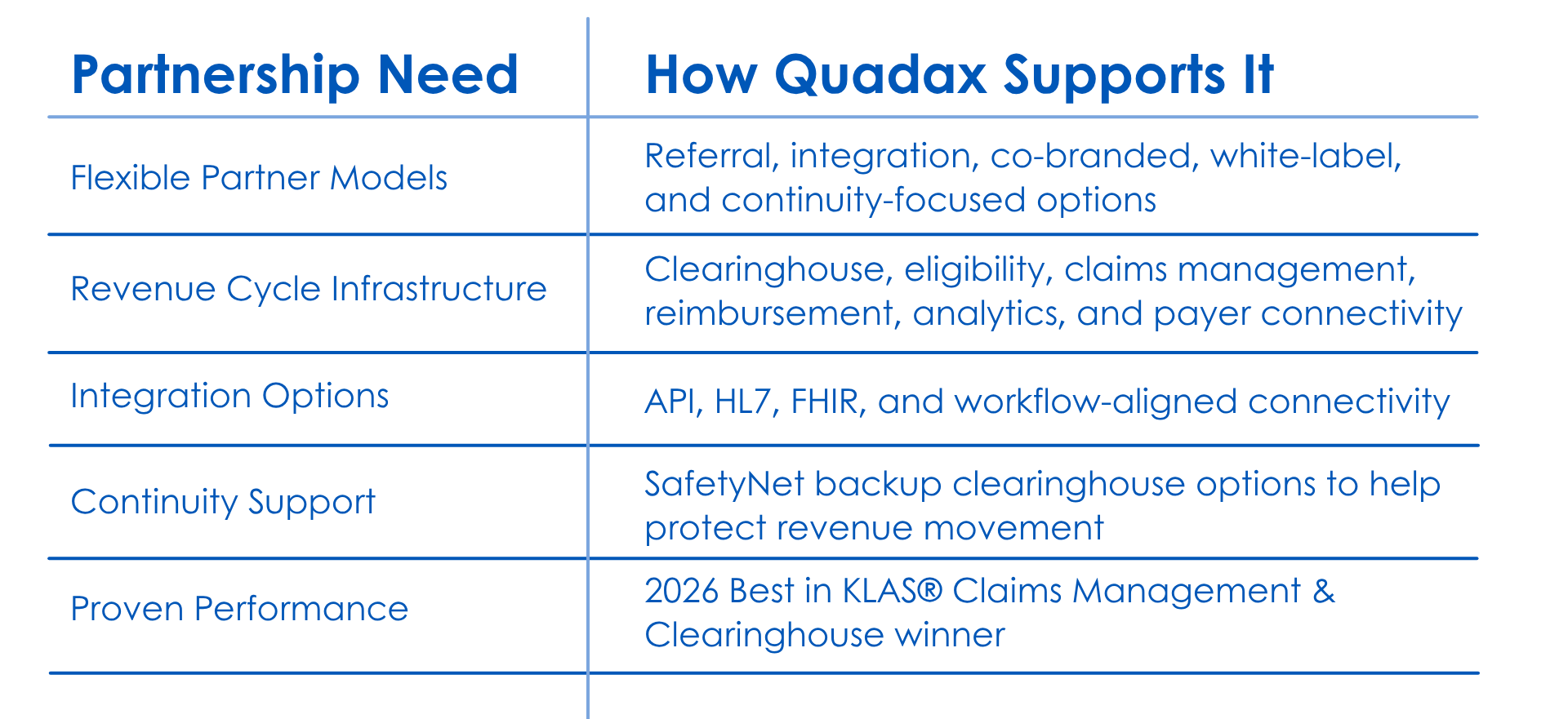
Through enterprise-grade clearinghouse capabilities, payer connectivity, eligibility, claims management, reimbursement support, analytics, and flexible integration options, Quadax helps partners expand the value they bring to their clients without having to build the infrastructure themselves.
.png?width=274&height=154&name=Podcast%20Thumbnails%20(4).png) In this Q’d Up podcast episode, John Leskiw, Vice President Sales, EDI Services (Quadax) and Monica White, Director of Product Management - RCM (Streamline Healthcare Solutions) discuss what makes a successful partnership in healthcare technology—and why Streamline chose Quadax for its customer-first, collaborative approach.
In this Q’d Up podcast episode, John Leskiw, Vice President Sales, EDI Services (Quadax) and Monica White, Director of Product Management - RCM (Streamline Healthcare Solutions) discuss what makes a successful partnership in healthcare technology—and why Streamline chose Quadax for its customer-first, collaborative approach. What this means for potential partners
The right partnership can help extend value without requiring partners to build every revenue cycle capability from the ground up.
-
EHRs can expand revenue cycle value inside their ecosystem.
-
Billing platforms can add stronger claims, eligibility, and payer connectivity capabilities.
-
Consultants can recommend solutions that improve performance and continuity.
-
Healthcare software vendors can deepen workflow and financial impact.
-
RCM organizations can extend service value without building new infrastructure.
The future of partnership is shared performance
The future of revenue cycle partnership will not be defined by connectivity alone.
It will be defined by the ability to help providers work smarter, reduce friction, improve financial performance, and stay prepared for disruption. The strongest partner relationships will combine integration, intelligence, trust, and resilience.
For healthcare technology vendors, EHRs, billing companies and RCM organizations, the opportunity is clear: build partnerships that create more value for clients and help revenue move forward with greater confidence.
Quadax is built to support that future.
Interested in exploring a partnership model that fits your strategy?
Connect with Quadax to learn more about referral, integration, co-branded, white-label, and continuity-focused partnership opportunities. quadax.com/partnership